Why Polyurea Sets in Seconds, and What That Speed Costs You
Polyurea gels in seconds because amines react with isocyanates far faster than polyols do. That speed buys moisture tolerance and same-day return to service, and it costs you flow-out, recoat windows, and any forgiveness for bad prep.
The first time somebody watches a polyurea job, the reaction is always the same. The applicator lays down a pass, and by the time he has walked back to the start of it, it is tack-free. You can stand on it. On a job where you would have lost two days to cure time with an epoxy, you are back in service before lunch.
That speed is the entire commercial argument for polyurea, and it is also the source of nearly every problem the material has. It is worth understanding where it comes from.
The reaction underneath it
Polyurea is what you get when an isocyanate reacts with an amine-terminated resin. That is the whole distinction. Polyurethane comes from an isocyanate reacting with a polyol — an alcohol — and the amine reaction is orders of magnitude faster than the alcohol one. Nobody is adding a catalyst to speed polyurea up. The chemistry is simply that eager.
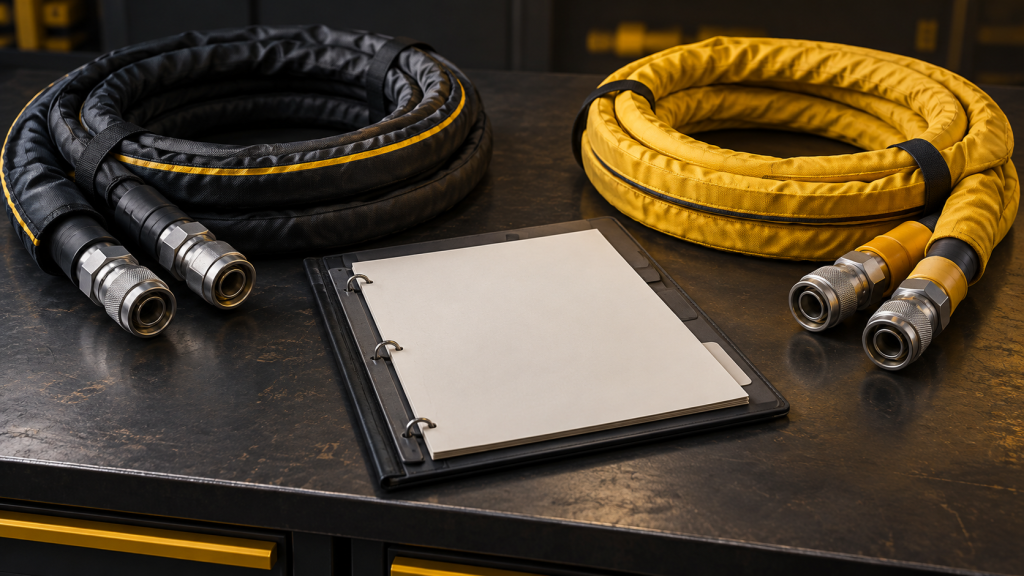
In practice you are running two components, usually at a 1:1 volume ratio. The A side is an isocyanate quasi-prepolymer. The B side is a blend of amine-terminated polyether resins and chain extenders. They do not meet until they are inside the gun, where they are driven together by impingement mixing at high pressure — typically in the neighborhood of 2,000 to 3,000 psi dynamic, with both sides preheated to somewhere around 150 to 180°F to get viscosity down far enough to mix properly.
Gel time is commonly a matter of seconds. Tack-free follows quickly after. That is not a formulation tweak, it is the nature of the reaction.
What the speed buys you
Moisture tolerance. This is the underrated one. A urethane system is in a race against ambient moisture, because water will react with free isocyanate and generate carbon dioxide, which is how you get foaming and pinholes on a humid day. Polyurea’s amine reaction is fast enough that it substantially outruns that side reaction. It is why the material tolerates conditions that would ruin a urethane, and why it can be sprayed at temperatures where most coatings have quit for the season.
Vertical build. Because it is setting as it lands, you can build serious film thickness on a wall or an overhead in a single pass without it sagging off. Try that with a slow-curing system and you will be chasing runs.
Return to service. On tank linings, secondary containment, and industrial floors, downtime is frequently the largest line item on the job — larger than the coating. A material that lets you hand the asset back the same day changes the economics of the project, not just the schedule.
What the speed costs you
There is no flow-out, and therefore no forgiveness. A slower coating levels itself. Small imperfections in your spray pattern get smoothed over as the material relaxes. Polyurea does not relax. Whatever the gun laid down is what cures. Surface texture, overlap arcs, dry-fall speckle at the edge of the fan — all of it is permanent within seconds. This makes finish quality almost entirely a function of the applicator’s technique, which is why two crews can spray the same drum of material and get visibly different results.
Recoat windows are short and unforgiving. Because the surface chemistry is consumed so quickly, the window in which a fresh pass will chemically bond to the previous one is narrow. Miss it, and your subsequent coat is bonding mechanically to a cured surface rather than chemically to a reactive one. That interface is a plane of weakness, and it is where delamination shows up eighteen months later. If you have to come back outside the window, the manufacturer’s instructions will generally call for abrading and often for a tie coat. That step gets skipped constantly, and it is expensive when it fails.
Mistakes are unrecoverable. If the ratio drifts, you find out after the material is on the substrate, because you cannot see off-ratio in the fan. There is no wiping it off. A tank of off-ratio material is a demolition job, not a rework.
Prep errors are locked in. A slow coating that penetrates has a small chance of overcoming marginal surface preparation. Polyurea skins over so fast that it has essentially no ability to wet into a dirty or contaminated substrate. Whatever adhesion you get is the adhesion you prepared for. This is the single most common cause of failures blamed on the material.
The part people get backwards
A lot of specifiers hear “cures in seconds” and file polyurea under easy. It is the opposite. The material is unusually tolerant of bad weather and unusually intolerant of bad workmanship, and those are different axes. A shop that has been doing solvent-based work for twenty years and buys a plural-component rig on Monday will produce failures for a while, and they will be prep failures and ratio failures, not chemistry failures.
If you take one operational thing from this: the speed does not save you time on preparation. It moves all of your available margin for error out of the cure phase and into the prep phase, where you have to spend it before the gun ever comes out.
General trade information, not a specification. Cure characteristics, ratios, pressures, and recoat windows vary by product — work from the technical data sheet for the material actually in your rig, and from its safety data sheet for exposure controls.
Spotted an error? We post corrections on the page itself, dated. Tell us what is wrong.
Disagree, or have a story like this? That is an episode. Pitch yourself as a guest.