The Coating Did Not Fail. The Prep Did.
When a coating delaminates, the failure surface usually tells you the coating never bonded at all. The four preparation failures behind most of it, how to test for them, and why prep is where bids get cut.
When a coating comes off a substrate, the phone call is almost never “we prepped it badly.” The call is “your material failed.” Then somebody drives out, pulls a piece of the delaminated sheet, turns it over, and finds a clean, glossy back face with the imprint of the concrete on it.
That imprint tells you everything. The coating never bonded. It cured beautifully as a free film that happened to be lying on top of something.
What adhesion actually is
Adhesion to concrete and steel is overwhelmingly mechanical. The coating flows into the profile of the surface, cures, and is now keyed into it. The chemistry contributes, but the profile does the work. Anything that reduces the effective profile — laitance, curing compound, old sealer, oil, dust, or a polished trowel finish — reduces adhesion proportionally, and no amount of material quality compensates.
This matters more for polyurea than for slower systems, because polyurea does not have time to wet into anything. It skins in seconds. It gets exactly the mechanical key you gave it and no more.
The four failures that account for most of it
1. Laitance left on the slab
The weak, fine layer that floats to the top of concrete during finishing has almost no strength of its own. A coating can bond to it perfectly and still come off, because the laitance separates from the concrete underneath. When the failure surface has a thin dusty film of concrete on the back, this is what happened. Abrasive blasting or shot blasting to a proper profile removes it. Acid etching frequently does not, and it leaves its own residue to deal with.
2. Moisture in the slab
Concrete on grade without a functioning vapor barrier will move moisture upward continuously. The coating goes down over a slab that looks and feels dry, and vapor pressure underneath pushes it off in blisters over the following months. The material never had a chance.
Test for it. ASTM F2170 uses in-situ relative humidity probes drilled into the slab and is the more reliable method; ASTM F1869, the calcium chloride test, measures surface emission and is easier but tells you less about what is happening deeper down. Either is better than the plastic sheet taped to the floor overnight, which is a rough screen and not a measurement. Know the manufacturer’s moisture limit before you schedule the crew, not after.
3. Curing compounds and old coatings nobody disclosed
Most new concrete gets a curing compound. It is designed to form a film that holds water in, which is to say it is designed to be a bond breaker. On renovation work you get the same problem from old sealers and coatings that the owner has forgotten about, sometimes several generations of them. Mechanical removal is the answer. A solvent wipe test or a simple water bead test will tell you something is there in about thirty seconds.
4. Profile that is too smooth, or too aggressive
Under-profiled is the common one — a hard-troweled floor that got a light sanding and nothing more. Over-profiled happens too, on aggressive blasts where the peaks are taller than the film build and the coating ends up thin over every high point. Those thin spots are where corrosion or wear starts. Match the profile to the specified film thickness rather than to habit. The ICRI concrete surface profile chips exist for this and cost almost nothing.
Test it before you coat the whole thing
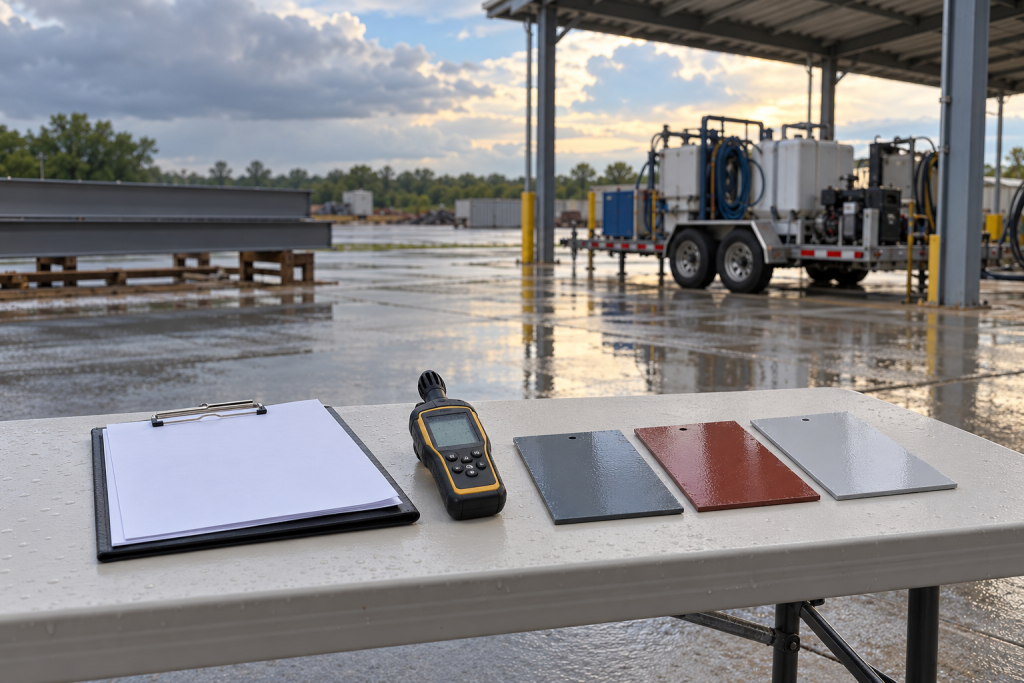
Pull-off testing per ASTM D4541 on a small trial area takes an hour and settles arguments that otherwise take lawyers. Do it on the actual substrate, with the actual prep method, with the actual product. Record the value and, more importantly, record where the break occurred: in the concrete (good — you exceeded the substrate’s own strength), at the interface (bad — adhesion problem), or within the coating (a material or application problem). The failure mode tells you more than the number does.
The uncomfortable business point
Prep is where bids get cut, because it is the least visible line item and the client cannot see it in the finished product. A crew that wins work by pricing prep thin is buying future warranty claims at a discount. The material sitting on top will get the blame, the manufacturer will get the call, and the contractor will pay for the second job either way.
If you are the one writing the spec: name the preparation standard, name the profile, name the moisture limit and the test method, and require documentation of all three before material goes down. It is the cheapest insurance in the project.
General trade information, not a specification. Preparation requirements, moisture limits, and profile specifications vary by product and substrate — follow the manufacturer’s written instructions for the system you are applying.
Spotted an error? We post corrections on the page itself, dated. Tell us what is wrong.
Disagree, or have a story like this? That is an episode. Pitch yourself as a guest.