Author: Troy Bacon
-

Episode Notes: What a First Year in Coatings Actually Looks Like
Nobody starts in this trade knowing what they don’t know. That’s not a knock on anyone, it’s just how the work goes. You learn to run a gun, you learn to read a substrate, and you learn most of the real lessons the hard way, usually on a job where something went wrong in a…
-
Why Polyurea Sets in Seconds, and What That Speed Costs You
Polyurea gels in seconds because amines react with isocyanates far faster than polyols do. That speed buys moisture tolerance and same-day return to service, and it costs you flow-out, recoat windows, and any forgiveness for bad prep.
-
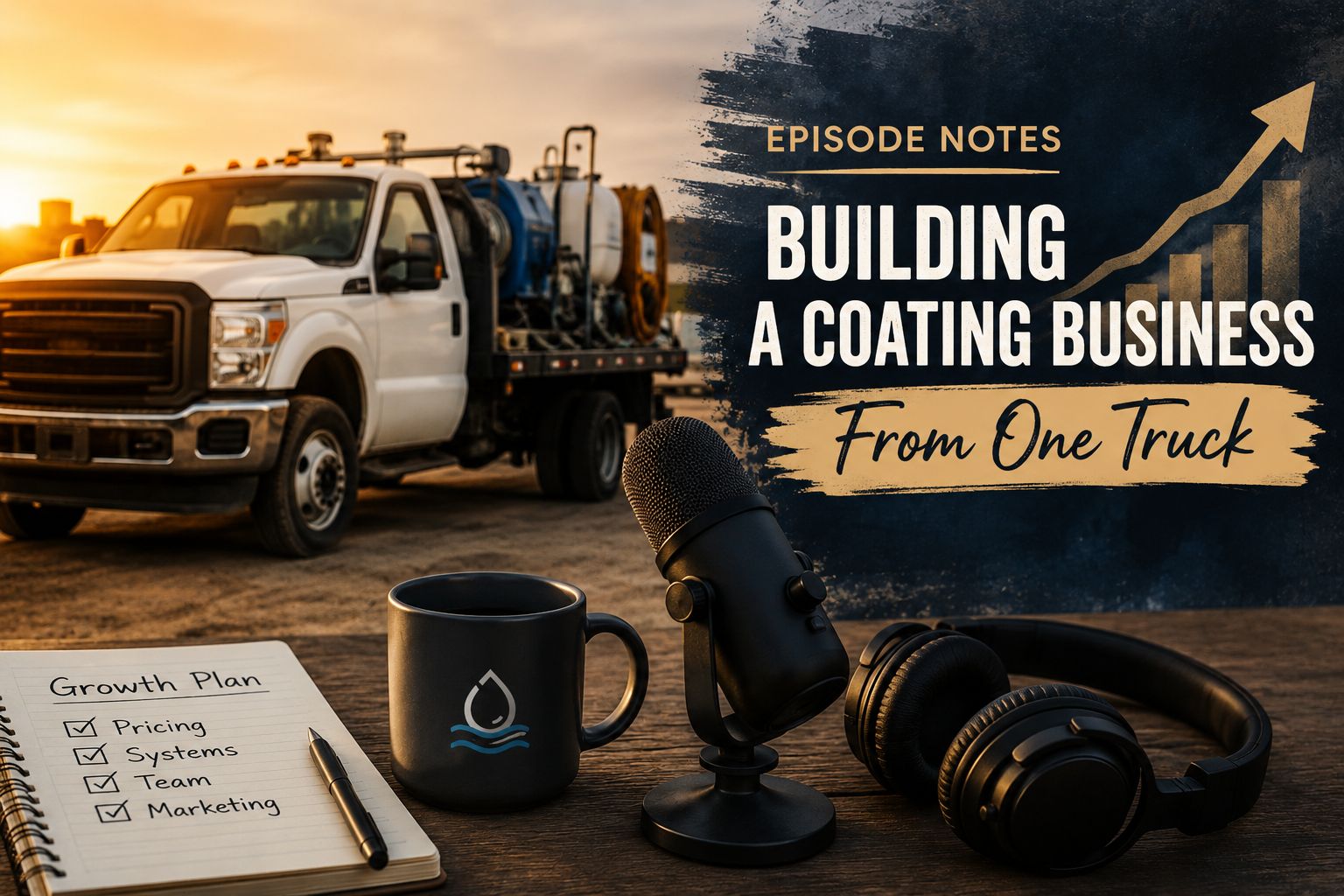
Building a Coating Business From One Truck
Most coatings businesses start with one truck, one rig, and one person answering every call. The four transitions that decide whether it grows past that, and the ceiling that shows up at each one.
-
Reading a Coatings Data Sheet Without Getting Fooled
A technical data sheet is a marketing document constrained by honesty, and there is room inside that constraint. How to read test methods, durometer scales, adhesion figures, and chemical resistance charts without being misled.
-
The Coating Did Not Fail. The Prep Did.
When a coating delaminates, the failure surface usually tells you the coating never bonded at all. The four preparation failures behind most of it, how to test for them, and why prep is where bids get cut.
-
Polyurea, Polyurethane, and Hybrids: What the Categories Actually Mean
Polyurethane is isocyanate plus polyol. Polyurea is isocyanate plus amine. Hybrids blend both. What that difference does to moisture sensitivity, working time, recoat windows, and UV behavior, and how to specify around it.
-
Off-Ratio: How Proportioner Drift Ruins a Tank of Material
Off-ratio material sprays normally and fails later. What resin-rich and isocyanate-rich films actually do, the five sources of ratio drift, and the ten-minute check that catches all of them.
-
What Contractors Get Wrong When Bidding Containment Work
The low bid on containment work is usually wrong in the same three places: thinned prep, details priced by square foot, and confined-space access nobody scoped. What to walk, what to count, and what to put in the bid.