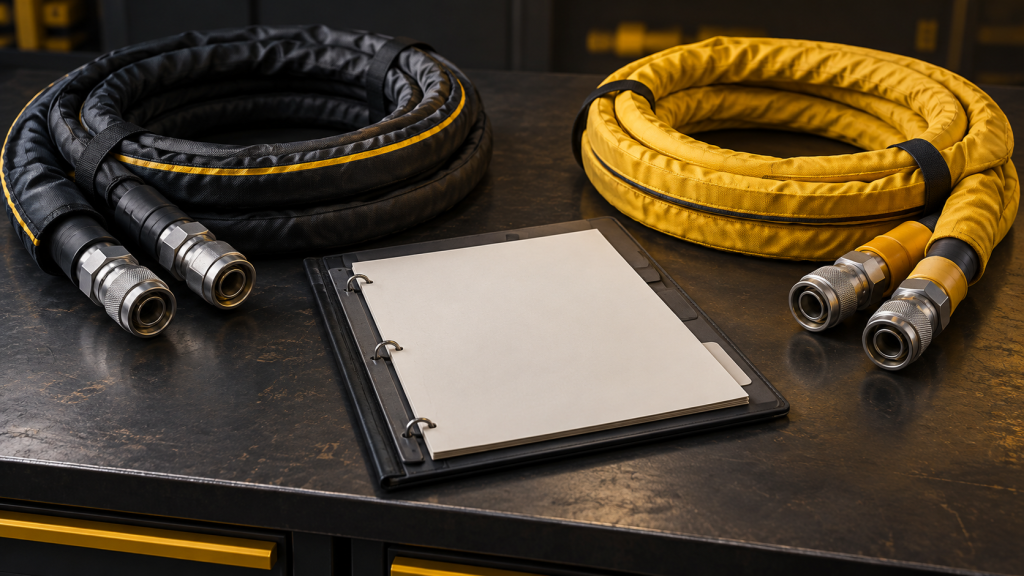
Inside a Working Mobile Spray Rig Setup
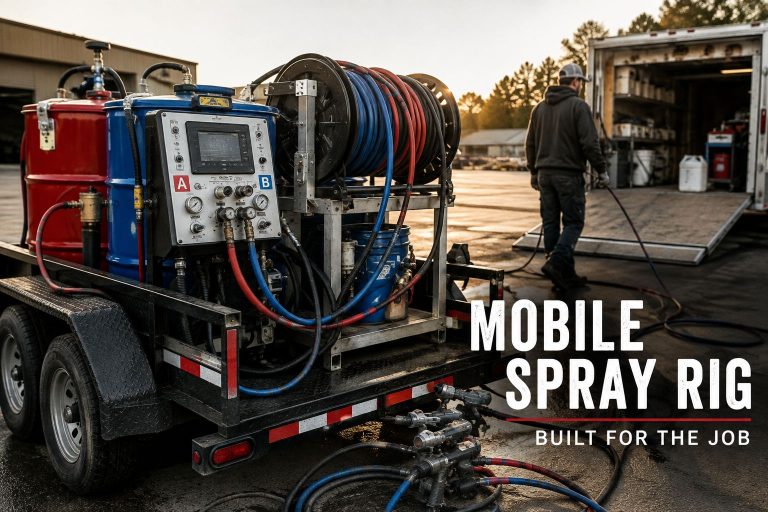
Every crew has an opinion about the right spray rig setup, and most of those opinions were formed the hard way, usually standing next to a proportioner at six in the morning wondering why the ratio just drifted. This isn’t a manufacturer’s brochure walkthrough of what a rig can theoretically do. It’s a look at what actually sits on a working trailer or truck bed, what separates a setup that holds up through a full day of hauling and spraying from one that leaves a crew stranded on a job, and where the corners people cut come back to bite them.
What Actually Sits on a Working Rig
Strip away the branding and every plural-component spray rig is built around the same core: a proportioner to meter and mix the two reactive components at the correct ratio, heated hose to keep material at spray temperature on its way to the gun, a generator or vehicle power takeoff to run it all, and drum heaters to bring incoming material up to working temperature before it ever hits the proportioner. Around that core sits the stuff that actually determines whether a day goes smoothly: hose reels sized for the job radius, an air compressor for atomization on air-assisted setups, ventilation for enclosed spraying, and enough spare parts and filters that a clogged screen doesn’t turn into a lost afternoon.
None of that is exotic. What separates a good rig from a problem rig is less about which brand of equipment is bolted to the trailer and more about whether the setup was actually built around the jobs the crew runs, instead of whatever configuration came standard from the dealer.
Spray Rig Setup: Getting It Right Before the Truck Rolls
A spray rig setup earns its keep before the crew ever gets to the job site. Pre-shift checks matter more than most crews want to admit when they’re trying to make an early call time: confirming both component drums are at proper temperature, checking that pressures on both sides are balanced and within the proportioner’s target range, and running a test shot to check the mix before spraying anything that actually needs to hold up. A rig that rolled off the last job without that check is a rig that’s gambling on the next one.
Hose length and reel placement matter more than they get credit for too. A rig set up for tight residential garages doesn’t necessarily work for a crew that regularly walks two hundred feet across a warehouse floor, and forcing one configuration to do both jobs usually means either wasted setup time or a hose run that’s fighting the crew all day. Matching the rig’s physical layout to the kind of jobs it actually runs, rather than a generic factory configuration, is one of the more overlooked parts of getting a spray rig setup right.
Temperature control deserves its own mention here, since it’s where a lot of ratio problems start before anyone even notices. Material that isn’t properly preheated behaves differently through the proportioner than material at target temperature, and that mismatch is exactly the kind of thing that produces a bad mix without throwing an obvious alarm. Our piece on how proportioner drift ruins a tank of material goes deeper into the specific ways ratio control breaks down mid-job, and it’s worth reading alongside this one if temperature and pressure discipline aren’t already part of your crew’s routine.
Trailer-Mounted vs. Truck-Bed Rigs
| Factor | Trailer-Mounted Rig | Truck-Bed Rig |
| Mobility | Detachable, can be left on site or swapped between trucks | Fixed to one vehicle |
| Setup footprint | Larger, more room for equipment and storage | More compact, tighter layout |
| Job site access | Can be tricky in narrow or residential access points | Generally easier to maneuver into tight spaces |
| Typical use | Larger commercial and industrial jobs | Residential, smaller commercial jobs |
| Equipment capacity | Room for larger generators, more hose storage, spare drums | Limited by bed size and payload |
Neither setup is the universally right answer. A crew running mostly large commercial and industrial jobs generally gets more out of a trailer’s capacity and flexibility. A crew that spends most of its week in residential driveways and tight commercial lots often does better with a truck-bed rig that can get in and out of spaces a trailer can’t touch.
Power and Heating: The Part That Gets Underbuilt
Generator sizing is one of the most commonly underbuilt parts of a spray rig setup, and it’s easy to see why. On paper, adding up the rated draw of the proportioner, drum heaters, hose heat, and any auxiliary equipment looks like it should leave comfortable headroom. In practice, startup draw, ambient temperature, and the reality of running everything simultaneously during a cold-weather job eats into that margin fast. A generator that’s technically sized correctly for steady-state load can still sag under startup or peak conditions, and that sag shows up downstream as heater cycling and temperature swings the crew doesn’t necessarily notice until the mix goes off.
Drum heating deserves the same scrutiny. Material brought up to temperature too quickly, or heated unevenly across the drum, doesn’t behave the same way through the proportioner as material that was properly and evenly conditioned. Cold weather operations in particular expose this: a rig that performs fine in summer conditions can reveal power and heating shortfalls the first time it has to fight actual winter temperatures to keep material in spec. Building in margin on both generator capacity and heating time, rather than running right at the edge of what the equipment claims it can do, is cheap insurance against exactly the kind of intermittent problem that’s hardest to diagnose after the fact.
Common Setup Mistakes
The same handful of setup mistakes show up across crews of every size, and almost all of them are avoidable with a bit of discipline rather than a bigger budget.
Undersizing the generator for the full rig load. A generator that’s adequate on paper but gets pushed to its limit running heaters, the proportioner, and everything else at once is a recipe for voltage sag that shows up as inconsistent heating and, eventually, ratio problems.
Skipping the pre-shift test shot. It takes a few minutes and it’s the single easiest way to catch a problem before it’s sprayed onto a customer’s floor or wall instead of into a test cup.
Letting hose maintenance slide. Heated hose that isn’t properly inspected for wear, kinks, or insulation damage doesn’t deliver material at consistent temperature, and inconsistent temperature at the gun is a direct path to inconsistent cure and adhesion. Our article on why polyurea sets in seconds, and what that speed costs you covers why that speed advantage is also less forgiving of exactly this kind of equipment sloppiness.
Ignoring the rig when a job goes fine anyway. A rig can run out of spec and still produce an acceptable-looking result on a forgiving job, which teaches a crew the wrong lesson. The problems show up later, on the job where conditions aren’t forgiving, and by then it’s a pattern instead of a one-off.
Blaming the material before checking the rig. When a coating underperforms, the material gets blamed first more often than it should. A disproportionate number of “bad batch” complaints trace back to a rig issue, not the drum. Our piece on why the coating did not fail, the prep did makes a similar case about surface prep, and the same instinct applies to equipment: check your own setup before assuming the product is the problem.
Things to Consider
Match the rig to the actual job mix, not the biggest job you’ve ever run. Overbuilding a rig for jobs that rarely happen adds cost and complexity to the setup you use every day. Build around the typical job, and plan separately for the occasional outlier when it comes up rather than carrying that extra capacity on every routine call.
Budget real time for maintenance, not just repairs. A rig that only gets attention when something breaks is a rig that breaks more often, usually at the worst possible moment. Scheduled filter changes, hose inspection, and heater calibration cost far less than a mid-job failure and the lost day that comes with it.
Train every operator on the same pre-shift routine. A rig is only as consistent as the person running it that day. Standardizing the startup and check routine across the crew, instead of leaving it to individual habit, closes a gap that shows up in inconsistent results between operators.
Keep spare parts on the rig, not back at the shop. A clogged filter or a worn seal is a five-minute fix with the right part on hand and a lost afternoon without it.
Maintenance
A working spray rig setup holds up over time the same way any piece of production equipment does: through routine attention rather than reactive fixes. Heated hose and drum heaters should be checked regularly for wear and calibration drift, filters and screens need scheduled replacement rather than run-to-failure use, and the proportioner itself should be checked against manufacturer specifications on a set interval, not just when output looks off. A logbook tracking maintenance and any anomalies noticed during pre-shift checks turns troubleshooting from guesswork into pattern recognition over time.
Frequently Asked Questions
What’s the biggest factor in a reliable spray rig setup?
Consistency in temperature and pressure control, backed by a disciplined pre-shift check routine. Most rig-related failures trace back to a drift in one of those two areas that went unnoticed.
How often should a proportioner be serviced?
This depends on the specific equipment and usage volume. The manufacturer’s service schedule is the reliable reference point, and usage-heavy operations generally need more frequent checks than the minimum interval.
Is a trailer-mounted or truck-bed rig better for a new operation?
It depends on the type of jobs the business expects to run most often. Residential and tight-access work tends to favor a truck-bed setup, while larger commercial and industrial work often benefits from a trailer’s added capacity.
Can a rig issue really look like a material problem?
Yes, and it happens more often than crews expect. Off-ratio material, inconsistent hose temperature, and generator power sag can all produce results that look like a bad batch when the equipment is actually the source.
What’s the fastest way to catch a rig problem before it affects a job?
A consistent pre-shift test shot and a habit of checking pressures and temperatures before spraying, rather than assuming yesterday’s settings still apply.
Does generator size actually matter that much for a small crew?
Yes. Undersized power is one of the most common, and most overlooked, causes of intermittent heating and ratio problems, even on rigs that look adequately equipped on paper. Building in margin rather than sizing to the bare minimum tends to pay for itself the first time conditions get demanding.
Conclusion
A spray rig setup that actually holds up isn’t about chasing the newest equipment on the market. It’s about matching the rig to the jobs a crew actually runs, keeping temperature and pressure discipline as a non-negotiable habit, and treating maintenance as a schedule instead of a reaction to breakdowns. The crews that rarely have equipment-caused failures aren’t running fundamentally different gear than everyone else. They’re running the same gear with a tighter routine around it, and that routine is usually the difference between a rig that pays for itself over years of steady work and one that turns into a rolling liability.
Spotted an error? We post corrections on the page itself, dated. Tell us what is wrong.
Disagree, or have a story like this? That is an episode. Pitch yourself as a guest.