How Experienced Applicators Price a Job

Ask five contractors how they price a coating job and you’ll get five different formulas, and at least three of them will admit, if you push a little, that the number they send the client is really a feeling wearing a spreadsheet’s clothes. That’s not a knock on anyone. Coating job pricing is genuinely hard to standardize, because the same square footage on two different sites can carry wildly different labor, and the people who get good at pricing usually got there by underbidding a few jobs badly enough to remember exactly which line item bit them.
These are the show notes from a conversation with an estimator who has priced coating work for a long time, spanning secondary containment, truck bed liners, tank linings, and everything in between. The conversation kept circling back to the same idea: pricing isn’t really about the material cost per square foot. It’s about correctly predicting everything that isn’t the material, because that’s almost always where a bid actually wins or loses money.
The Number Everyone Starts With Is Rarely the Number That Matters
Most people new to estimating start with material cost per square foot at the specified thickness, and that’s a reasonable place to start, but it’s also the easiest part of the whole exercise. Material cost is printed on an invoice. Everything else on a job has to be estimated, and estimation is where experience actually separates a profitable bid from a bid that looks fine on paper and loses money in the field.
The applicator’s framing on the show was blunt: if your price is built mostly around material cost plus a labor multiplier, you’re pricing the job you hope you get, not the job you’re actually going to do. Real pricing starts with a walk-through, or at minimum a genuinely honest conversation with the client about site conditions, because the site is what determines labor, and labor is usually the bigger number.
Surface Prep Is Where Bids Quietly Fall Apart
This came up almost immediately, and it tracks with something covered in more depth in The Coating Did Not Fail. The Prep Did. Most of what looks like a coating problem later actually started as a prep problem, and the same logic applies directly to pricing. Prep is the line item that’s hardest to estimate accurately and the easiest one to underbid, because it’s rarely uniform across a job and it’s the part a client can’t meaningfully verify from a proposal.
Concrete that looks fine in photos can have oil saturation, curing compound residue, carbonation, or microcracking that only shows up once grinding or blasting actually starts. Steel that looks clean can have mill scale variation or old coating remnants in corners a walk-through misses. The applicator’s rule of thumb: if you haven’t personally walked the substrate, or had someone you trust walk it, price the uncertainty into a contingency line rather than assuming the best case. Bidding prep off a description or a set of photos is one of the more reliable ways to turn a profitable-looking job into a break-even one.
Square Footage Lies About How Long a Job Actually Takes
A second theme that came up repeatedly: square footage is a terrible predictor of labor time on its own, because it says nothing about geometry. A flat, open floor and a floor broken up by sumps, curbs, pipe penetrations, and equipment pads can carry nearly identical square footage numbers and completely different labor hours.
This is almost exactly the pattern covered in What Contractors Get Wrong When Bidding Containment Work, where wall-to-floor transitions, penetrations, and joint detailing account for a disproportionate share of the labor relative to how little square footage they actually occupy. The applicator on the show made the same point from a pricing angle rather than a technical one: count the details individually and price them individually, because lumping them into a blended square-foot rate is how a job with forty penetrations gets priced the same as a job with four, right up until the crew is three days behind schedule on the first one.
Material Choice Changes the Whole Cost Structure, Not Just the Material Line
Choosing between polyurea, polyurethane, and hybrid systems isn’t purely a technical decision, it’s a pricing decision too, and this connects directly to the distinctions laid out in Polyurea, Polyurethane, and Hybrids: What the Categories Actually Mean. A fast-gelling polyurea changes production rate, crew size needs, and how much downtime the client absorbs, which affects the labor side of the bid as much as the material line does.
The applicator pointed to Why Polyurea Sets in Seconds, and What That Speed Costs You as required reading for anyone pricing polyurea work who hasn’t fully internalized what that cure speed means for scheduling. Same-day return to service sounds like a pure advantage, and mostly it is, but it also removes any margin for a slow crew to fix a mistake mid-application, which is a real cost consideration when staffing a job, not just a chemistry footnote.
Equipment and Mobilization Costs Get Forgotten More Than They Should
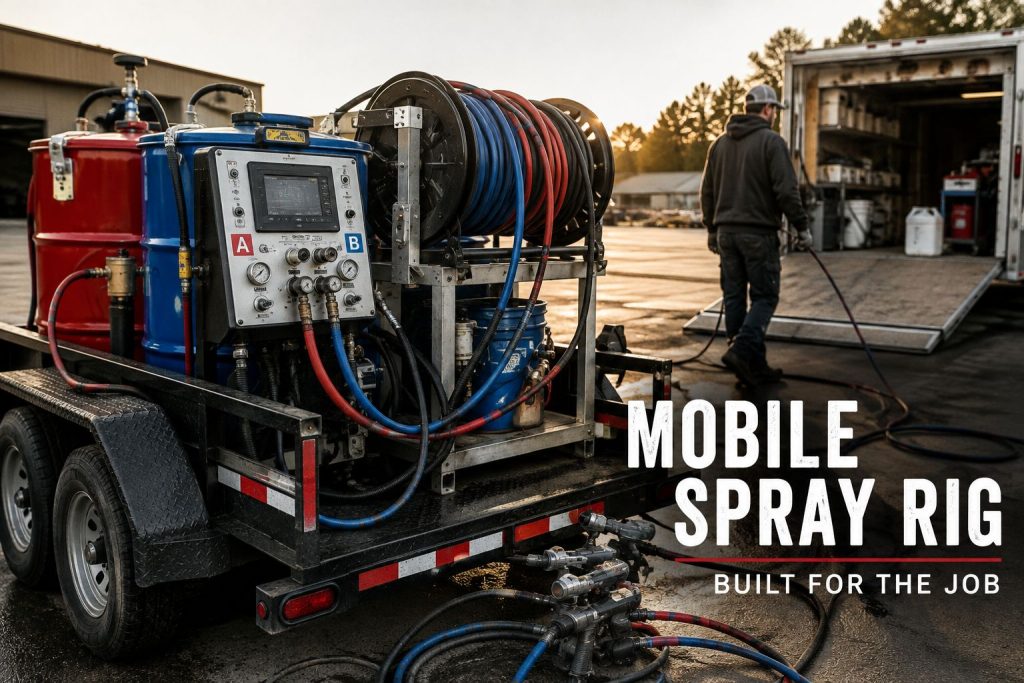
A recurring mistake, according to the conversation: contractors price the job itself carefully and then treat mobilization, proportioner setup, generator fuel, and equipment wear as background noise that’s already baked into overhead somewhere. On a local job that assumption mostly holds. On a job requiring a mobile rig to travel, set up, and run for multiple days, it doesn’t.
The show’s earlier piece, Episode Notes: Inside a Working Mobile Spray Rig Setup, walks through what a working rig setup actually involves, and the applicator referenced it directly when talking about pricing travel jobs. Fuel, travel time, lodging for a multi-day job, and simple equipment wear from a harder-than-usual application all belong somewhere in a bid, and “somewhere in overhead” isn’t a real answer if overhead wasn’t actually calculated with those variables in mind.
Proportioner performance is its own pricing consideration too. A rig that’s drifting off ratio doesn’t just create a quality problem, it creates a cost problem through wasted material and rework. Off-Ratio: How Proportioner Drift Ruins a Tank of Material covers the failure modes directly, and the applicator’s point was that a shop with a documented, disciplined proportioner-check habit can genuinely price tighter than a shop that’s implicitly pricing in occasional wasted tanks of material as an unspoken cost of doing business.
Reading the Client’s Data Sheet Requirements Before Pricing the Job
Some jobs come with a spec that names a specific product, and some come with a spec that names performance requirements a contractor has to match with an appropriate product. The applicator flagged this as a common pricing trap: bidding against a competitor’s data sheet numbers without actually understanding whether those numbers are directly comparable.
Reading a Coatings Data Sheet Without Getting Fooled breaks down why adhesion figures, durometer readings, and chemical resistance data aren’t always tested the same way across manufacturers, and that matters for pricing because a contractor who prices to match a competitor’s stated numbers without checking test methodology can end up either overspecifying, and losing on price, or underspecifying, and inheriting a callback down the line that eats the margin the low price was supposed to protect.
A Rough Anatomy of a Coating Job Price
The applicator walked through a simplified breakdown of where the money in a typical bid actually goes, with the caveat that the exact split moves around a lot depending on job type.
| Cost Category | Typical Share of Bid | Where It Gets Underbid |
|---|---|---|
| Material | 20–35% | Rarely this is the easiest number to get right |
| Surface preparation | 25–40% | Most common place bids fall short |
| Labor and detail work | 20–35% | Underestimated when geometry is complex |
| Equipment, mobilization, consumables | 5–15% | Often folded into overhead without real math |
| Testing, documentation, contingency | 5–10% | Frequently left out entirely on smaller jobs |
The applicator was clear that these percentages aren’t a formula to plug numbers into blindly. They’re a checklist. A bid missing an entire category, testing and documentation being the one that gets skipped most often on smaller jobs, isn’t a lean bid. It’s an incomplete one that happens to look competitive.
Documentation Isn’t Free, and Pricing Should Reflect That
One point from the conversation that doesn’t get talked about enough: thickness verification, adhesion testing, and holiday or spark testing all cost real time, and that time belongs in the price, not treated as a courtesy thrown in to win the job. On regulated work especially, the client isn’t just buying a coating, they’re buying proof the coating was installed correctly, and proof has a labor cost attached to producing it.
Contractors who leave documentation out of the bid entirely are either planning to skip it, which creates real risk if a coating is ever questioned later, or planning to absorb the cost of doing it anyway, which quietly erodes margin on every job that includes it. Neither is a great position to be in, and the applicator’s advice was to price it as its own line item so the client sees exactly what they’re getting for it.
Building a Bid That Survives the Actual Job
- Walk the site, or get someone trustworthy to walk it, before pricing prep. Photos and a written description are not a substitute.
- Break geometry-heavy work into individual priced details rather than a blended square-foot rate.
- Match the coating chemistry to the schedule and crew size the job actually needs, not just the spec sheet minimum.
- Price mobilization, equipment wear, and consumables explicitly, especially on any job requiring travel.
- Include testing and documentation as a named line item rather than folding it into a vague markup.
- Build in a defined contingency for concrete or substrate repair discovered mid-job, with a clear rate for who pays for it.
What Separates an Experienced Estimator From a New One
The applicator’s closing point on the show was that a new estimator tends to price the job described on paper. An experienced one prices the job they expect to actually encounter, which is very often a slightly different job once the crew shows up and starts grinding, blasting, or masking. That gap between the described job and the real one is exactly where contingency, honest site assessment, and a track record of past jobs going a little sideways all come into play. It’s not pessimism, it’s just accounting for the version of the job that history says is more likely to show up.
Frequently Asked Questions
What’s the biggest mistake contractors make when pricing a coating job?
Underestimating surface preparation, either by bidding off photos instead of a real walk-through or by assuming a substrate is in better condition than it actually is once work begins. This single line item causes more underbid jobs than material cost or labor rate ever does.
Should coating job pricing be done strictly by square footage?
Square footage is a starting point, not a complete pricing method. Jobs with heavy detail work, penetrations, transitions, or confined access can carry similar square footage to a simple, open job while requiring significantly more labor, so those details need to be priced individually.
How much should contingency add to a coating bid?
There’s no universal percentage, since it depends on how much of the substrate condition is actually known before work starts. A job with a thorough pre-bid inspection needs less contingency than one priced from limited information, where more of the risk is genuinely unknown.
Does the type of coating material change how a job should be priced?
Yes. Faster-curing materials like polyurea change production rate and crew requirements, which affects labor cost, not just the material line. Chemistry choice should factor into scheduling and staffing decisions as much as it factors into the raw material cost per square foot.
Should testing and documentation be included in every coating bid?
On any job where verification matters, which includes most regulated or performance-critical work, yes. Leaving it out either means it won’t happen, which creates risk, or it happens anyway and quietly reduces the contractor’s margin, since the labor cost of testing doesn’t disappear just because it wasn’t priced.
Conclusion
Pricing a coating job well isn’t about finding a better formula than the next contractor. It’s about correctly predicting the parts of the job that don’t show up in a square-foot number: surface condition, detail work, equipment and mobilization, and the documentation the client actually needs. The estimators who consistently price profitably are the ones who’ve learned, usually the hard way, exactly which corners of a job tend to hide the real cost, and who’ve built a process that accounts for those corners before the bid goes out rather than after the crew is already on site. Everything else, the material cost, the labor rate, the markup, is comparatively easy to get right once those bigger variables are actually accounted for.
Spotted an error? We post corrections on the page itself, dated. Tell us what is wrong.
Disagree, or have a story like this? That is an episode. Pitch yourself as a guest.