Episode 1: Why This Show Exists, Chemistry in Plain English & the Number That Makes a Job Pay
Episode 1 is live. Why this show exists, polyurea chemistry in plain English, a field tip for concrete outgassing, and the one number that decides whether a job makes money.

- Apple PodcastsSoon
- SpotifySoon
- YouTubeSoon
- RSSSoon
The first episode of The Polyurea Podcast is live. Troy Bacon and co-host Sam lay out what this show is, who it’s for, and what you can count on hearing every time. Then they get into the chemistry, a field tip you can use this week, and the one number that decides whether a job makes money or loses it.
Hit play at the top of the page to stream the full episode right here.
In this episode
- 0:00 Cold open: the chemistry is the fast part
- 0:56 Welcome to The Polyurea Podcast
- 2:13 Why this show exists, and who it’s for
- 3:46 What you’ll get every episode
- 5:19 Polyurea chemistry in plain English
- 9:07 Field tip: concrete outgassing and pinholes
- 10:59 The number that decides if a job makes money
- 13:21 Where the industry is moving
- 15:01 Send in your questions, and what’s next
Polyurea chemistry in plain English
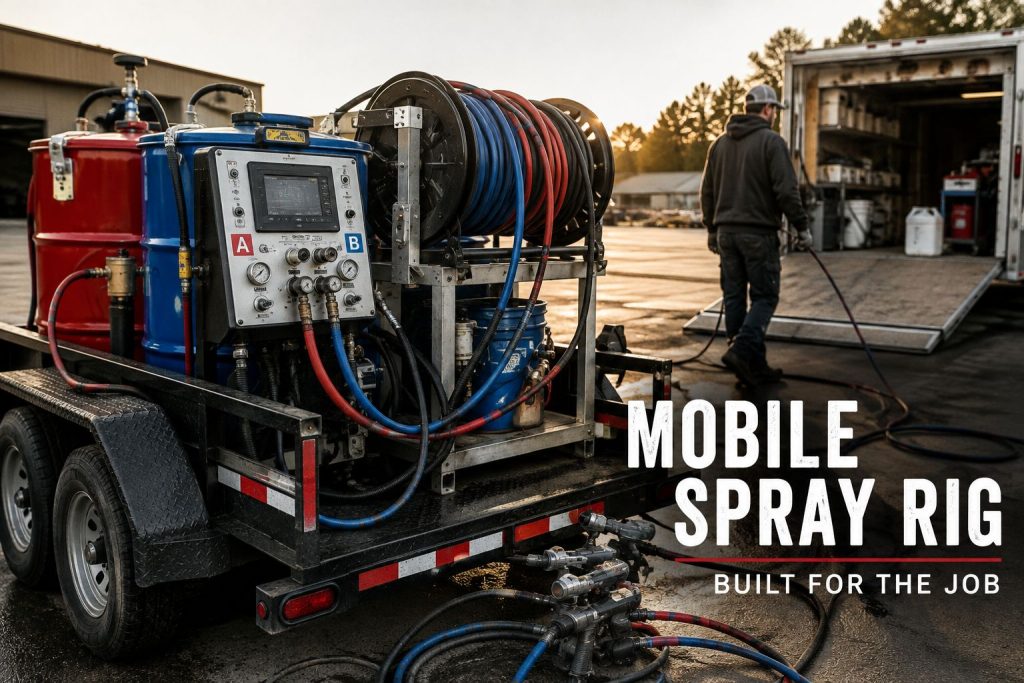
Two sides: the A side is an isocyanate, and in a true polyurea the B side resin blend is built on amines. Amine meets isocyanate, you get urea linkages, and the whole thing gels in seconds. That is why it is sprayed hot, at high pressure, and mixed right at the gun. There is no pot life.
That speed is also why polyurea is more forgiving of humidity in the air than most people expect: the amine wins the race against water, so you get far less CO2 foaming than a slower system. It is not forgiving of a wet surface, though. Water on the substrate is still a bond problem.
Aromatic systems yellow and chalk in UV, which changes the look but usually not the protection. Aliphatics hold their color and cost more, so a common approach is an aromatic base with an aliphatic topcoat wherever looks matter. Polyaspartics are a kind of aliphatic polyurea built to react slower, which is why you see them rolled on floors and topcoats.
For reading alongside the episode, Coatingpedia is a free coatings encyclopedia covering chemistry, preparation, application and inspection. Its polyurea guide goes further into pure, hybrid and aliphatic systems.
Field tip: concrete outgassing
- Watch which way the temperature is going. A warming slab pushes air out through your coating. Spray on a falling temperature when you can.
- Prime it. A good penetrating primer seals the pores first. Your supplier’s tech data sheet tells you which primer fits your system.
- Check dew point. Most specs want the surface at least 5°F above dew point.
- Write it all down. Surface and air temp, humidity, dew point, mil readings, batch numbers, photos. It is your best defense and one of your best sales tools.
The number every applicator should know cold
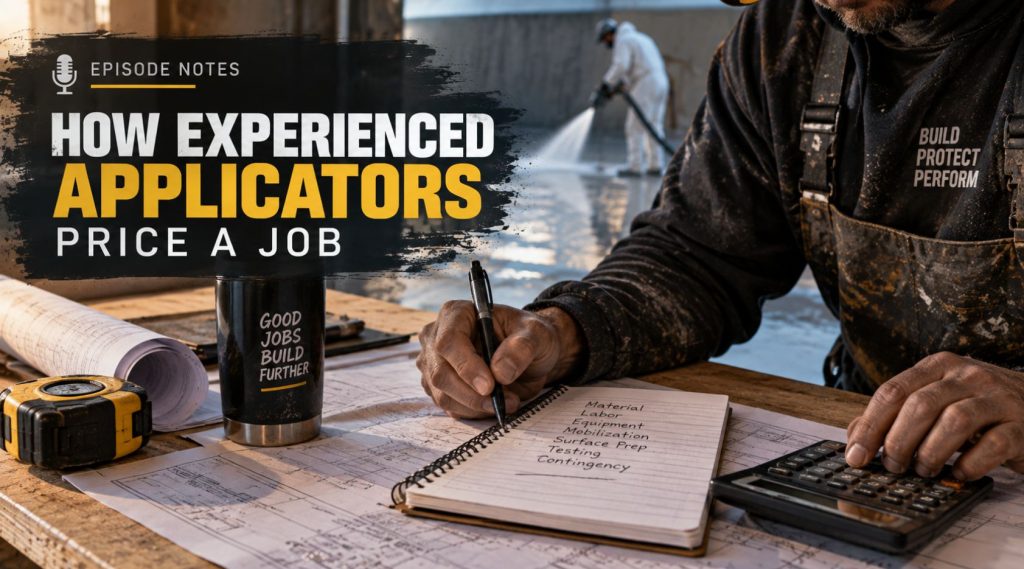
One gallon of 100% solids material spread exactly one mil thick covers about 1,604 square feet. At 60 mils that drops to roughly 27 square feet per gallon, and that is on paper, before overspray, low spots and edges. Pricing by the square foot without thinking about thickness is how good applicators end up giving material away. Price the prep, too: grinding, blasting, patching and masking are labor, and labor is usually where a job is won or lost.
Where the industry is moving
Polyurea is showing up well beyond bedliners: infrastructure, water and wastewater, secondary containment, roofing, pools, even blast mitigation. More uses means more people in the trade and more pressure to get it right. Keep an eye on raw material supply, and take isocyanate safety seriously: training, respiratory protection and following the SDS are not optional.
Send us your questions
Stuck on something? Have a job that went sideways? Send it in, and you do not have to put your name on it. Know an applicator, engineer or equipment tech with something worth sharing? Tell us about them.
Next time: surface prep, the part of the job nobody wants to talk about and everybody pays for.
Disclosure: Troy’s day job is with ArmorThane. This show covers the whole industry and is not a commercial.
Spotted an error? We post corrections on the page itself, dated. Tell us what is wrong.
Disagree, or have a story like this? That is an episode. Pitch yourself as a guest.